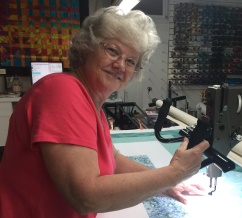
Mitered Corners – You can do this!

A mitered border is a more time consuming corner to make, but one that adds a quality look where your angled seem comes together in a 45-degree angle.  This mitered corner technique becomes easier and easier as you do a few and is well worth the finished look.  In this book I have used different corner and border techniques.  I have done that so you, the reader can see the distinct difference that a mitered corner makes.

Calculating your strips for a mitered corner is similar for measuring for a non mitered corner or border.  Length plus width of the border times 2 plus 16” for the total amount of length needed in the size needed.  So, to get this number, again, measure the length times width times two and add 16” for seam allowance because you are cutting this length into four pieces and you need 2” on each side to miter.  Again, this is the total amount of fabric needed.   I recommend measuring your quilt on both sides and width in a few different places to make sure your quilt is square and thus you do not run short on your border fabric.

Cut two strips to be 4” longer than the width of your quilt.  Cut two strips the length size of your quilt plus four inches each.

Fold your strips in half and put a pin in the center of each strip.

If you are using multiple borders do this for each border and then starting at your center pin, sew these strips together.

Place a pin in the center of your completed borders.  Place a pin in the center of all four sides of our quilt.  You can do this by measuring or by folding your quilt in half and placing the pin in the completed top of your quilt.  Match these pins letting the extra border length lap over the ends.

Double check your quilt center by folding the quilt top in half and verify your centers.  Now fold your border fabric in half and verify your centers.

Pin the center of your first length piece to the center of your quilt length mark so now your border and your quilt top center are connected.  Begin your sewing at the center pin and sew out toward the edge.  Leave ¼” away from the edge of the quilt top un-sewn.  Make sure to secure the ends solidly by a back stitch or three.  Sew the complete strip on leaving your ¼ inch away from each edge.  Do this with all four borders, leaving the end fabric of two inches on each side overlapping.
Fold the quilt top in half diagonally with right sides together. Line up the two borders, on top of each other with the fold running at a 45-degree angle between the two. Put your triangle square on the 45-degree angle over your quilt and out on the border fabric that extends out.  Use your pencil or water soluble ink to make your visual mark to follow out onto the border and pin the border pieces and quilt into place.
Now sew your corner over the line that you created with your ruler. Make sure to lock your start and finish with a back stitch or two on either side of your angled border.

Unfold your quilt make sure your borders lie flat and you have no spaces in your quilt or border that is not firmly stitched together.

Trim your border to 1/4″ seam and iron.

Do this same method for the other three corners.

Congratulations you have mitered corners and it was easy! 


Pillow Cover Activity Quilt

Activity quilts are not just for tables and wheel chair laps.  Activity quilts can come in the form of pillows, lap quilts, hand warmers sometimes called twiddle muffs and other forms.

The purpose for the activity quilt is to give idle hands something to do.  It is also to challenge the mind and bring familiarity to someone who is either mentally or physically limited.  Exercise, learning, occupational therapy and entertainment are all important uses for an activity mat sometimes referred to as a fidget quilt.

These are 18 x 18 inch pillow covers.  That means not only do they act as an activity mat that can be laid in their lap or their table, but a pillow can also be inserted to give a different feel and use in a bed to create happiness and alleviate loneliness or idle feelings.

Consider getting many types of activity quilts for loved ones to brighten up every atmosphere and add variety to not only create activity, but also to create conversation and attention, so your loved one in a nursing home half way across the country will be getting more smiles and interaction than they might without one in their space.

Happy Quilting and God bless the patients and the families and the care givers.

Dementia Needs

After the realization is over and we try to find our new normal life we find that we may need more than just a little help adjusting.  Group counseling and medical professionals go a long way to helping us understand and grasp with our new needs, but some things we may need to consider in the back ground that is less important are the day to day pleasantries and necessities.

Alzheimer’s like age may make us less mobile and less mobile means our bodies don’t get the exercise they did and we become colder.  We need a blanket.  We may even be in a wheel chair.  https://www.etsy.com/shop/SylviasQuiltingCraft   has a wheel chair cover that tucks in around your feet so that it does not get caught in the wheels.


After the consideration of warmth is the question of where your loved one is.  Is the stroke patient at home with people they love or in a facility?  Once the therapy is over are they in their facility room or enjoying the company of everyone else there?  If they are debilitated and may fidget or are nervous or lonely, mailing or bringing them some love like a fidget quilt may be something you might want to consider if you can’t be there every day with them.

We created fidget quilts after my mother-n-law was in a nursing home and many times when we visited her, there were six to twelve wheel chairs of individuals just sitting facing the nursing desk, faces blank and seeming lonely and bored.  I wanted to put something bright and beautiful in their laps that would not only give them something to feel and do but give them a reason to smile and share.  I wanted everyone who walked by them to smile and converse with them and this would maybe be that reason that made the interaction happen.  Here are some of the fidget quilts and activity mats that I and mom have created.  Please find them and more on https://www.etsy.com/shop/SylviasQuiltingCraft

God Bless and remember, one day at a time.  One smile is precious.

https://www.etsy.com/shop/SylviasQuiltingCraft

How would I quilt a bird?

Raw edge applique quilt is something you can do if you can draw or trace an outline.  For those of us who can not draw free form, try taking a black and white copy of your image and blow it up to a size that is comfortable to trace.

Trace the photo on a blank sheet of paper.  Now you have your outline.  Cut out your object or bird that you traced.

Take your fabric that you have already ironed your iron on adhesive to the back side or wrong side of your fabric.  Place your cut out object, a bird in this example on the paper side of your fabric.  Trace your cut out which is now your pattern.

Cut out your pattern.

Remove the paper by putting a small slit in your paper on the back of your fabric with scissors or a needle.  Pull off the paper.  Place your cut outs on your solid fabric and iron into place.

Too easy?  Smile.  Yes, too easy.  So birds have more than one color.  Take for instance:

Selecting fabric could be the hard part.  For a seagull you need the white, the gray and the black and some shad of red for the tip of the beak and feet.

For a lorikeet, you may need the green in one or more shades, the blue, yellow, orange and red.  And don’t forget gray for the feet.

The more detail, the harder the raw edge applique quilt, but the prouder you will be of the outcome.

Happy Quilting.

Did your loved one have a stroke?

Perhaps and activity quilt could be beneficial.  It may bring them smile and be beautiful for other people to comment on and bring them more smiles.

I tell my children when I get old and into a nursing home to give me a different photo album every time they visit.  Can’t visit often?

Give me an activity mat that I can hold instead of fidget or scratch.  Idle hands are fidget hands.  familiar feels and activities can help a stroke victim relearn how to zipper, button or tie a shoe.

It should bring comfort and recognition on some level to calm the person with memory loss.

What was their favorite color?

What was their favorite texture?

What type of item would be familiar to them?  a Washer and a bolt?  a Fishing weight or fishing bobber?  A spool of thread?  Fur, silk or satin that might feel like the edge of their childhood blanket?

Sometimes the brain works, but it miscommunicates what the fingers should do, an activity mat can help the brain and fingers re-link and start to relearn activities that we take for granted.

Tell me what you want.  Let me create it for you.

Raw Edge Applique Quilting

Raw edge applique is one of the easiest way for a scrapbook-er or painter to jump into the quilting field.

Clearly if you like quilting, you love fabric and desire to collect and create it into your own masterpiece.

Raw edge applique can be tried for small wall hangings or throw pillows and is a great project to test the waters into quilting.

You need to collect your fabrics and decide what art picture you want to create.  An easy way to get started is by someone else’s pattern, such as this one on Etsy:

https://www.etsy.com/listing/589713633/raw-edge-applique-pattern-self-portrait?ref=shop_home_active_24

The pattern will tell you how much fabric and materials you need, but assume you don’t have the pattern.

Consider a face or self portrait quilt.  1 fat quarter of quilter’s cotton for the front, one for the back of the quilt and an art size package of batting.  I like 14″ for the face, 15″ for the batting and 16″ for the backing so you can sandwich your raw edge art quilt.   You will also need a yard of light iron on paper backed adhesive.  There are many kinds.  You can buy all materials in any quilt store, most craft stores or even most Walmart’s have these items.

You will need two pair of scissors, one for the paper and one strictly for fabric as paper dulls the blade and makes cutting fabric much more difficult.

For the face (or any design you desire) I like to have at least 8 scraps of fabrics and matching threads.  I like buying pre-cut  packs of fabric so I can take advantage of multiple colors and shades of colors.

You will also need your iron, ironing board, sewing machine and normal sewing supplies.

Now you are ready to begin.  Lay out your “iron on adhesive” paper side down.  Rough side up.  Lay your fabrics out on your material face side up.  Try to cover all spaces, leaving none of the iron on adhesive showing.

Use a presser sheet or wax paper if you have it to keep your iron clean.  Slowly iron your fabrics face side up, by touching down, raising and touching down in a different spot until you believe all the iron on adhesive has been secured to the fabric, then you can gently iron using the directions on your adhesive paper.

Let cool.  When completely cool, you can turn your fabric over to have your paper side face up.  Draw your designs on the appropriate colors you have selected.

Cut out your design.

Turn your pieces back paper side up, use your scissors, wide open, to make a small cut as if touching a knife to the paper to barely cut through the paper.  This can also be done with a needle to start a spot in the center of your design to then pull the paper from your fabric.  Throw your paper away.

Audition your cut outs on your 14 inch fabric.

When you like it, walk away, come back a minute later and make sure you are happy with it’s appearance.  If yes, iron it down, by gently touching and lifting, touching and lifting the iron.  Once the pieces are secure you can iron normally.

Take your piece to your sewing machine.  I like to use freezer paper or your batting with your top fabric design together before sewing.

I like to use a zig zag stitch width at a 5 to create a “satin” stitch.    You can experiment between a 2.5 and 5.5 for the stitch length depending on the size of your fabric pieces.

Zig zag stitch in the appropriate color around every single piece on your art quilt.

Congratulations!  You are an artist.

Alzheimer Needs

After the realization is over and we try to find our new normal life we find that we may need more than just a little help adjusting.  Group counseling and medical professionals go a long way to helping us understand and grasp with our new needs, but some things we may need to consider in the back ground that is less important are the day to day pleasantries and necessities.

Alzheimer’s like age may make us less mobile and less mobile means our bodies don’t get the exercise they did and we become colder.  We need a blanket.  We may even be in a wheel chair.  https://www.etsy.com/shop/SylviasQuiltingCraft   has a wheel chair cover that tucks in around your feet so that it does not get caught in the wheels.

After the consideration of warmth is the question of where your loved one is.  Is the stroke patient at home with people they love or in a facility?  Once the therapy is over are they in their facility room or enjoying the company of everyone else there?  If they are debilitated and may fidget or are nervous or lonely, mailing or bringing them some love like a fidget quilt may be something you might want to consider if you can’t be there every day with them.

We created fidget quilts after my mother-n-law was in a nursing home and many times when we visited her, there were six to twelve wheel chairs of individuals just sitting facing the nursing desk, faces blank and seeming lonely and bored.  I wanted to put something bright and beautiful in their laps that would not only give them something to feel and do but give them a reason to smile and share.  I wanted everyone who walked by them to smile and converse with them and this would maybe be that reason that made the interaction happen.  Here are some of the fidget quilts and activity mats that I and mom have created.  Please find them and more on https://www.etsy.com/shop/SylviasQuiltingCraft


https://www.etsy.com/shop/SylviasQuiltingCraft

Tell me about your Autistic child

I would love to make a quilt for them.

What I would ask is perhaps,  what is their favorite color?  What color seems to calm or comfort them.

What is their favorite texture?  do they like to run their nail over bumps or hug a fur teddy bear?  Could we line their pockets with fur?

Sound, what sound comforts them and what do they like to hear?  Is it Velcro opening and closing?  a zipper, a bell or clinking small wood beads together.

What activity do they need help with?  Zippers?  Shoe laces?  buttons?  Snaps?

Would a clear pocket that you can enter cards with the next activity or their name on it be beneficial.  Maybe a pocket with a photo of their teddy bear/room/you?

Tell me what you want.  Let me create it for you.

Alzheimer’s quilt

What do you look for in an Alzheimer’s Quilt?

It should bring comfort and recognition on some level to calm the person with Alzheimer’s.

What was their favorite color?

What was their favorite texture?

What type of item would be familiar to them?  a Washer and a bolt?  a Fishing weight or bobber?  A spool of thread?  Fur, silk or satin that might feel like the edge of their childhood blanket?

Tell me what you want.  Let me create it for you.


Stroke Patient Needs

After the emergency is over and we try to find our new normal life we find that we may need more than just a little help adjusting.  Group counseling and medical professionals go a long way to helping us understand and grasp with our new needs, but some things we may need to consider in the back ground that is less important are the day to day pleasantries and necessities.

Stroke like age may make us less mobile and less mobile means our bodes don’t get the exercise they did and we become colder.  We need a blanket.  We may even be in a wheel chair.  https://www.etsy.com/shop/SylviasQuiltingCraft?ref=ss_profile has a wheel chair cover that tucks in around your feet so that it does not get caught in the wheels.


After the consideration of warmth is the question of where your loved one is.  Is the stroke patient at home with people they love or in a facility?  Once the therapy is over are they in their facility room or enjoying the company of everyone else there?  If they are debilitated and may fidget or are nervous or lonely, mailing or bringing them some love like a fidget quilt may be something you might want to consider if you can’t be there every day with them.

We created fidget quilts after my mother-n-law was in a nursing home and many times when we visited her, there were six to twelve wheel chairs of individuals just sitting facing the nursing desk, faces blank and seeming lonely and bored.  I wanted to put something bright and beautiful in their laps that would not only give them something to feel and do but give them a reason to smile and share.  I wanted everyone who walked by them to smile and converse with them and this would maybe be that reason that made the interaction happen.  Here are some of the fidget quilts and activity mats that I and mom have created.  Please find them and more on https://www.etsy.com/shop/SylviasQuiltingCraft

Blog at WordPress.com.

Up ↑